Hi folks,
Of late there has been a lot of hue and cry about start-ups in India. The cause championed by our Prime Minister, Mr. Modi himself has just surfaced it at a more visible level. ‘Start-up India’ is the buzz word doing the rounds among excited engineers and MBA students who want to break rules and capture market share in a different way. I arrived at the beautiful campus of IIT Bombay (flanked by the Powai lake) to know more about what the start-up biggies had in mind for the next 2-3 years. Has India really transformed into an ecosystem favorable for new ventures? Which industry is going to experience disruption in the coming months?
The event started off with Mr. Harsh Mariwala, founder of Marico telling us that in order to become a good entrepreneur one should either work in a start-up or find a job as a consultant in a company catering to several start-ups. This will make us familiar with the thick of things and give us a decent exposure before starting our own venture. Talking about familiarity, IIT- Bombay already has an option for both engineering and MBA students to pursue a Minor Degree in Entrepreneurship. I think it would be a good option for many B-schools in the country to provide a similar flexibility. There are many budding entrepreneurs especially in the Tier-2 cities who crave for guidance and mentor-ship and are unable to gain access to the big investors. Entrepreneurship as looked on by the Indian government should essentially add value to the Indian society and not be solely profit oriented. In order to add greater value to the Indian society one has to reach the bottom-of-pyramid as stressed by Mr. Nagarajan representing the Govt. of India and Make In India campaign at the summit. Tier-2 cities entrepreneurs have to play the greater role here. In short, the money flow has to be in this way. Tier-2 entrepreneurs should come up with innovative ideas to solve the problems of the Tier-3 cities and rural India, funded by the financial biggies in cities like Mumbai, Bengaluru and Gurgaon. Why can’t people from the metro cities do the same? Because they simply are unwilling to get their hands dirty! Also, people from Tier-2 cities have a relatively better understanding of the market in the rural area.
There is one BIG misconception which every budding entrepreneur has- ‘I am a Non-IT guy so essentially I cannot do a startup’. The misconception is justified in every sense because we have been witness to the e-commerce ventures such as Flipkart, Snapdeal followed by the taxi aggregators, real estate and hotel aggregators, hyperlocals etc. all of which appear to be tech-intensive start-ups. But sadly we happen to ignore the operations which are managed on the back end. We fail to realize that every tap of button on the app is leading to physical execution of services. There are no robots managing the process in entirety. In other words, apps are just facilitating the execution of orders by different professionals working in the company. Discussing more on it, Jim Beach, the faculty head at the The School for Startups, US shared a sure-shot secret to success-‘There are many small-scale profitable industries in India whose owners are in their sixties and seventies and preparing for retirement’. He urged all the Civil, Mechanical, Chemical and Electrical engineers to grab the opportunity of taking command of their already profitable businesses and turn them into billion dollar companies.’We need not idolize the Bansals of the tech-world to become rich’, he continued as people would need houses, cars, chemical products and power. That is something which Flipkart, Myntra and the likes can never step into! Nikesh Arora of SoftBank fame is probably already thinking on those lines considering the fact that he has invested half a billion dollars in the company and is the 2nd largest shareholder. Masayoshi Son needs someone to succeed him, doesn’t he?
There were confessions from the other end of the table when Tarun Davda, MD, Matrix Partners bared that often his role doesn’t allow him to fund start-ups even if the team and their B-plan is convincing simply because they do not fit the slender bracket of models accepted by the company for investment. He further exposed the problem of ‘herd-mentality’ followed by venture capitalists i.e. when they see others making investment in a profitable business-sector they blindly make investments without much consideration. This he said gives rise to many players in the start-up ecosystem catering to the same need. This in fact is one of the reasons for creation of the start-up bubble in various sectors. People follow a pattern he explained, ‘When food-tech start-up wave hit India, VC firms started funding a start-up only because their competitors invested in food-tech. They sometimes fail to register that their operational model may be different.’

Sachin Bansal, Rahul Yadav at E-Summit’16
The first day ended on a high note with Sachin Bansal and Rahul Yadav sharing the stage and answering candidly to all the questions put across to them by Abha Bakaya, Bloomberg TV. Here are some of the candid responses made by these two IITians:-
Q to Sachin Bansal: Did you find Rahul’s B-plan good enough to fund?
SB: Well, 90% of the B-plans change in the first 6 months of their execution, so I rarely focus on the B-plan.
(Rahul’s reply): Maine life mein kabhi B-plan nahi banaya. Pele bhi investors ke paas jaata tha. Jo B-plan ki PPT maangte the unse funding nahi li, baakiyon se leli. (With a grin)
The bad boy of Indian start-ups further said that he was unhappy the way things in India were and put the government to blame for most of them. He complained about the poor infra-structure in the best of engineering institutions like IIT Bombay. Fed up by this poor governance, he said that he would leave India for US if his next start-up doesn’t work well here as he does not want to “waste” his life in pollution, traffic jams and old-school teaching methods professed at the premier Indian institutions. Railways have lost 3% of their customers this year but no one in the government is analyzing the statistics, let alone working on it. In a follow up question in which he was asked what would he do provided one day he had the free will to do anything, he casually replied- I would go to the Himalayas and settle there. Because I love the greenery and the scenic beauty of that place, he added.
Sachin Bansal left the audience with the message to think on bigger problems and not build on start-ups which are catering to micro-issues in metro cities. ‘India has many problems, go after solving them. Every innovative solution to a major problem would be a billion dollar idea in itself.’
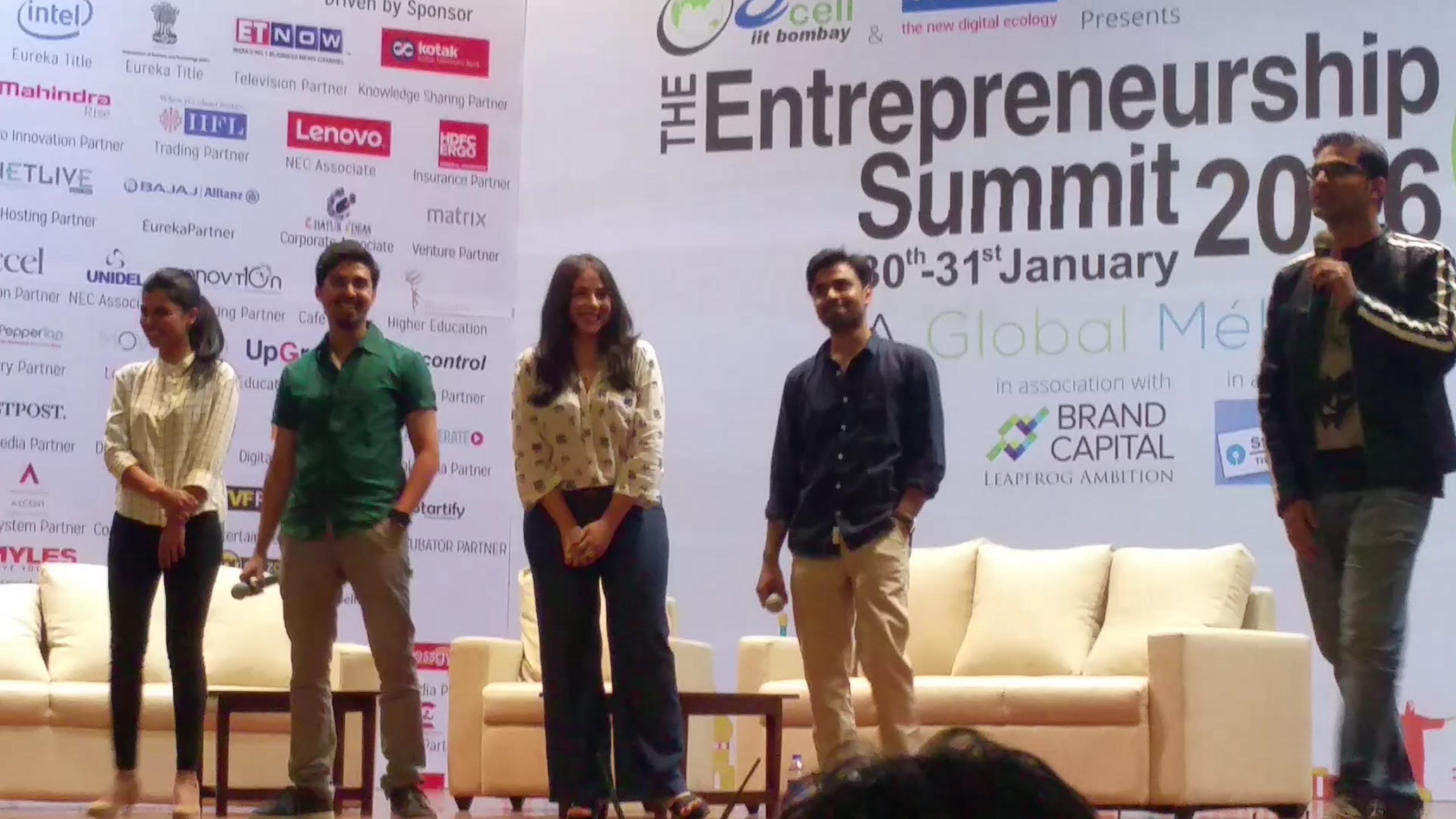
TVF Pitchers Team
There was a surprise in store for us in the form of TVF Pitchers onstage performance. Contents of the show are too explicit to share in this blog post. One could see happiness in the eyes of founder of TVF, Arunabh Kumar, when he said that during his engineering days at IIT, he used to feel bad that none of the daily serials made in India were in the top 250 list at imdb.com despite the fact we were a 1.2 billion population. But now his very own series TVF Pitchers was at #22 in the imdb ratings for TV series. The crowd thundered with claps and there was just one shout which could be heard – ‘Tu Beer Hai BC!!!’
 Nandu speaks
You must be logged in to post a comment.